“Saving Through Warp and Weft”
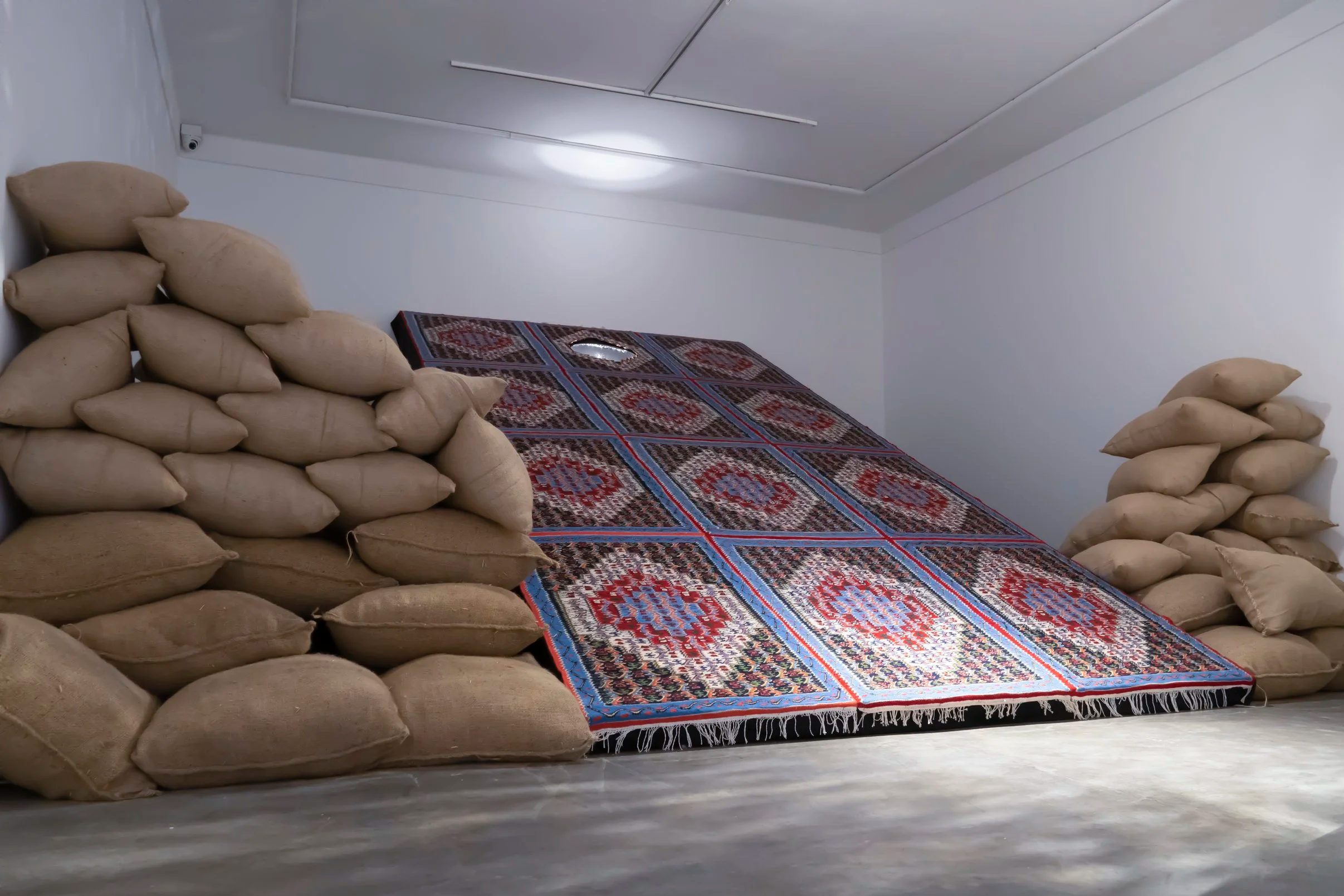
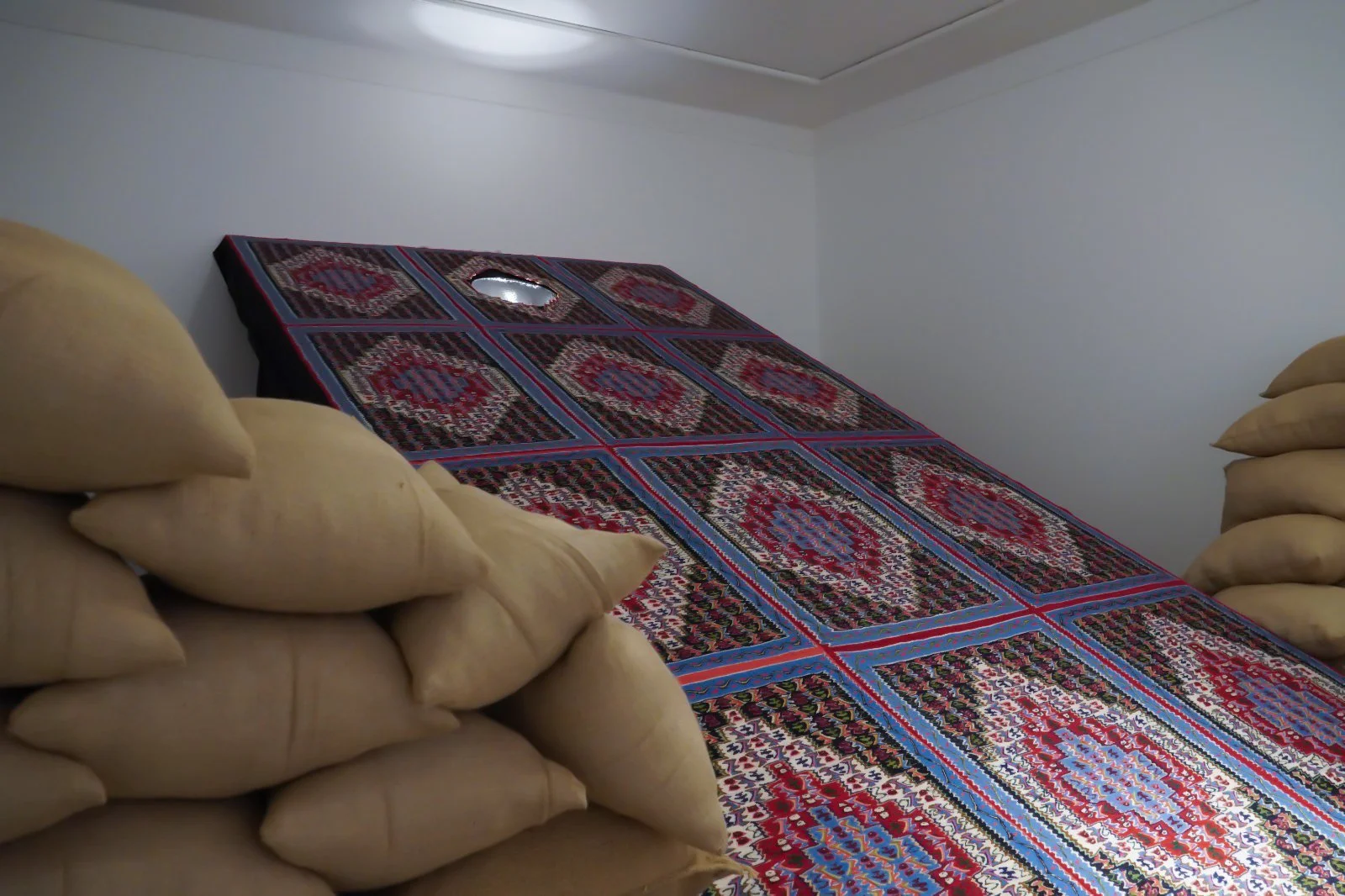
10x14x7.5 Feet, Sculpture, Sine Kurdish kilim (Kurdish: Suja), wood, fabric, burlap bags, and mixed media, 2025.
Sine Suja is a special woven kilim. Sine is my hometown in Rojhelat (eastern) Kurdistan, which has a very unique style of rug and kilim making that is world famous for the special techniques used in weaving, knot making, dying, and loom building.


In Kurdistan, most families used to have a rug or kilim loom, on which women would engage in weaving on their free time or intensively, depending on the household's economic dynamic. My grandmother was not an exception; she made rugs and kilims (Suja in our Kurdish dialect), and I would help her after school.
After the formation of the nation-state of Iran in 1935 by the Pahlavi dynasty (1925-1979) and the centralization of power, economy, and means of production, Kurdistan became a colonized land categorically through policies and multiple military campaigns. This process was increasingly intensified by the Islamic Republic(1979-today), the de-development policies in Kurdistan, and issues of coloniality and securitization of Kurdish livelihood created a devastating impact on all aspects of our lives, including crafts and especially the field of weaving, because it was a primarily female-operated labor. To further solidify their control over all aspects of this crucial craft in Kurdistan, they began monopolizing it by severing the organic relationships between Kurdish sheep owners, wool spinners, dyers, loom builders, and weavers. Once a fully connected web of people engaged in this work was broken, and each had to sell their product to the centralized traders, which resulted in impoverishing all of the parties involved and making them further dependent. Additionally, on the international market, they began branding it as Persian Tribal Rug, Persian rug, or Sine-Persian Kilim, and categorically further obscured the Kurdish craftsmanship and rebranded it, in some collections, even today, if there is a mention of Kurdish Kilim, it is described as a “tribal mountainous people in the west of Iran.”
My grandmother, though, would go to the nearest village, pick and choose materials from the spinner, take them to her trusted dyer, and work for nobody. This slowed her process, and it was always a major issue, but she continuously resisted being enslaved by the people in Tehran. She normally exchanged them for what she needed and did not want to be paid. Most of the time during Iran’s war against the Kurds and the Iran-Iraq war, I sat by her and helped while she made the Kurdish struggle intelligible to a very young kid through Kurdish mythology, stories of Torah, and folklore wisdom.
This piece is in conversation with my other body of work, “When The War Ended We All Wondered: What Should We Do Now?” and “The Re(in)flections of a Scabbing.”
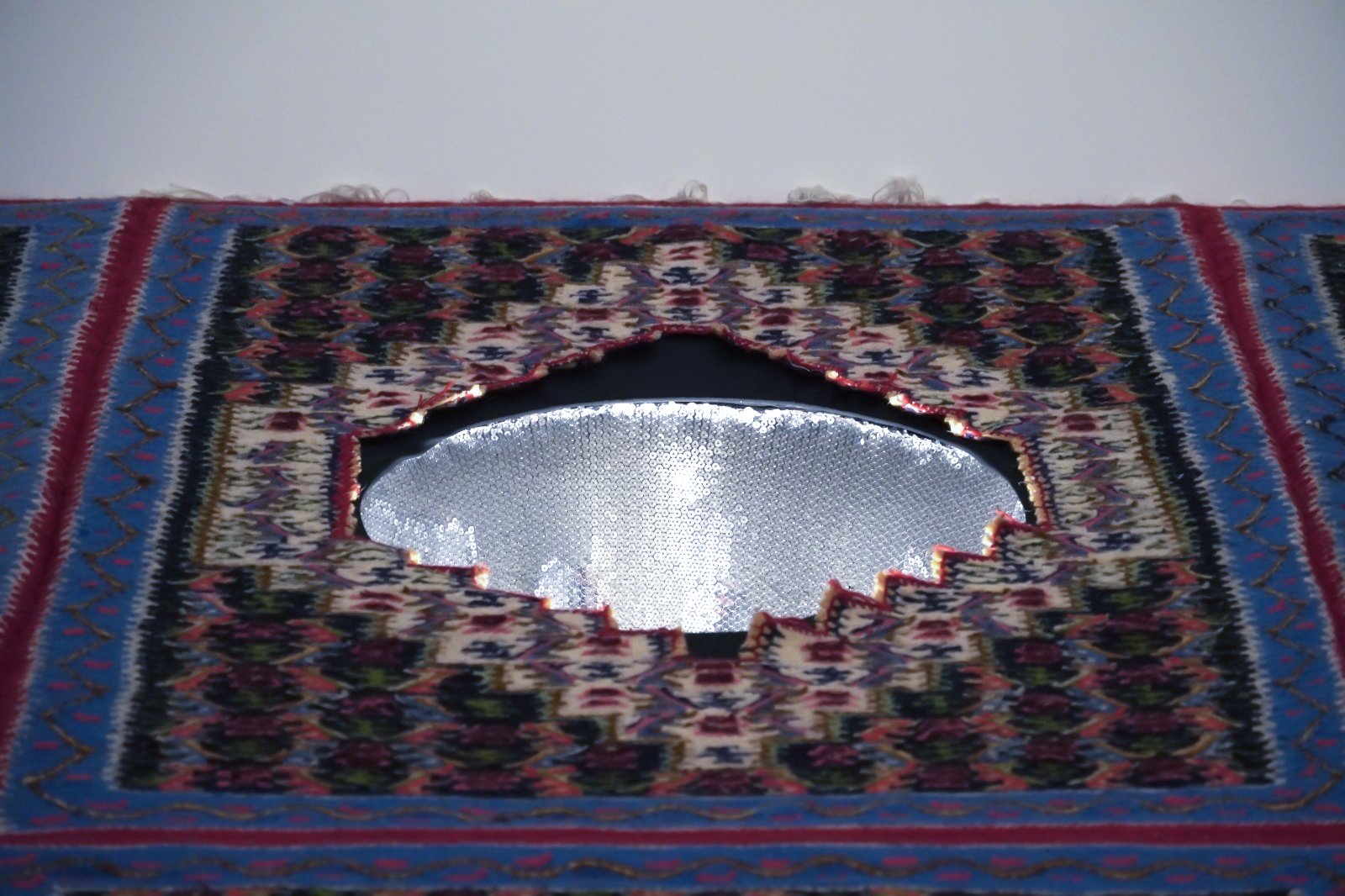
I created this piece by gathering the exact pattern of Suja, which I helped her make many times, called “Masî Derhem” in Kurdish (Mixed Fish), from my hometown. I then created a sloped slab with a hole, which is the outline of the center of one of the Sujas. This becomes the central part of mirrorwork sculpture, “The Re(in)flections of a Scabbing.” These two pieces are a tribute to her and other Kurdish women who have accomplished the impossible task of passing down the legacy of perseverance, resistance, and defiance to the next generation. Her loom and the “Masî Derhem” were a safe haven from the colonizers and the pain of seeing family members in prisons for political views and war.
The hole in this piece is a hyperbola with the narrow side up, created using Silver Sequin Fabric, which is illuminated from the floor to highlight the ceiling of the space.